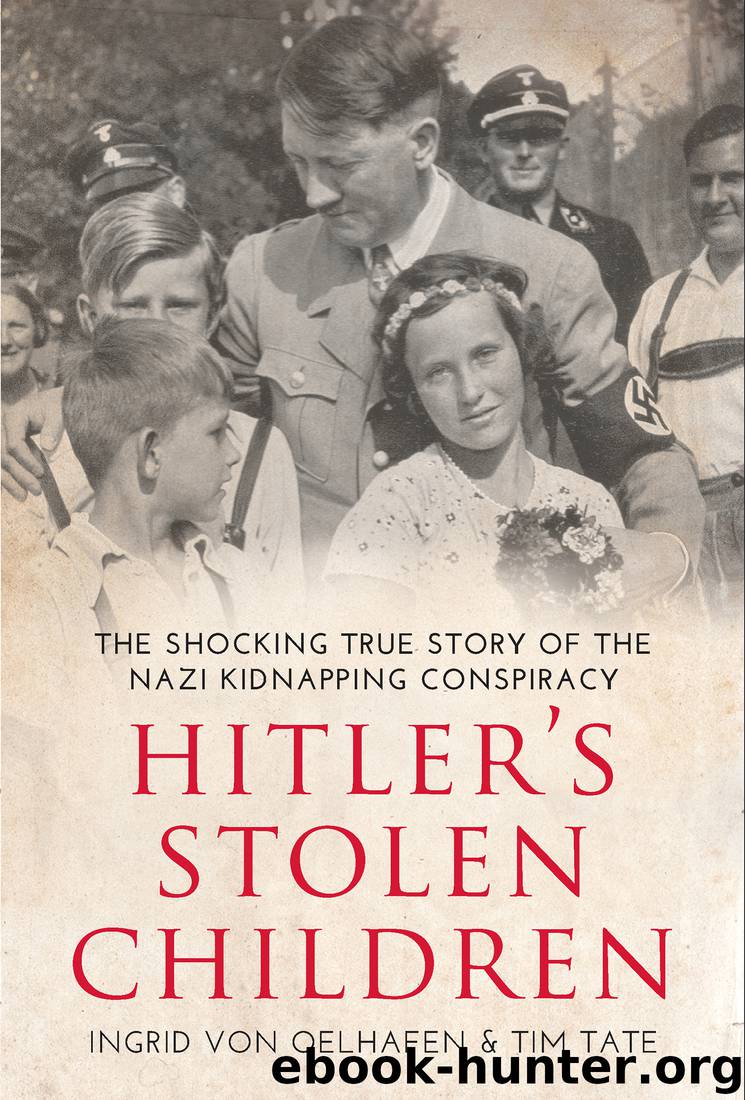
Hitler's Stolen Children by Ingrid Von Oelhafen
Author:Ingrid Von Oelhafen
Language: eng
Format: epub
Publisher: HarperCollins Canada
Published: 2020-01-16T16:00:00+00:00
Twelve
Nuremberg
Lebensborn was responsible, amongst other things, for the kidnapping of foreign children for the purpose of Germanization . . . numerous Czech, Polish, Yugoslav and Norwegian children were taken from their parents.
INDICTMENT, THE NUREMBERG MILITARY TRIBUNALS, CASE 8
IT WAS SPRING 2003 by the time I set off on the five-hundred-kilometer drive south.
Nuremberg was the dark heart of National Socialism. Between 1927 and 1938 it was the city where Hitler held spectacular torchlit rallies—serried ranks of tens of thousands of supporters screaming Sieg Heil beneath an ocean of swastika banners, all captured for melodramatic propaganda films—and where the 1935 Race Laws that signaled the start of the Holocaust were promulgated.
To the controlling minds of the Nazi Party, the city’s position at the very center of the country symbolized, in some mystical way, the connection between the Third Reich and the supposed Aryan supermen of Himmler’s imagination. It was also heavily fortified—a fact that made it one of the last cities to fall to the Allied forces in the last weeks of the war. Despite systematic bombing that destroyed 90 percent of the medieval center, it was captured only after four days of fierce house-to-house fighting.
The three main Allied Powers had long planned to mount public trials of the Nazi leaders. On November 1, 1943, the Soviet Union, the United Kingdom, and the United States published a joint “Declaration on German Atrocities in Occupied Europe,” which gave “full warning” that as and when the Nazis were defeated, the Allies would “pursue them to the uttermost ends of the earth . . . in order that justice may be done . . .”
For the next eighteen months, as their armies slowly inched their way to victory, lawyers and politicians from all three countries hammered out a set of innovative legal principles under which Hitler and his henchmen could be prosecuted for war crimes and crimes against humanity. When the war ended the only remaining question was where to hold the hearings.
Leipzig and Luxembourg were briefly considered and rejected. The Soviet Union favored Berlin—“the capital of the fascist conspirators”—as a suitably symbolic location, but the overwhelming destruction suffered by the city made it impractical. The decision to choose Nuremberg was based on two key factors. Its role in the Nazi propaganda machine made it an appropriate site to dispense exemplary justice; but more importantly, its spacious Palace of Justice had survived the war largely intact—and its buildings included a large prison facility.
The surviving leaders of the Third Reich were brought to the cells beneath the courtroom in November 1945. Hitler himself had cheated justice, committing suicide in the Führerbunker amid the flames and ruins of Berlin. Himmler, too, had taken the coward’s way out, swallowing a cyanide capsule while in captivity. But twenty-two others—including Reichsmarschall Hermann Göring and Deputy Führer Rudolf Hess—were brought before the International Military Tribunal and arraigned for the crimes of the Nazi regime. Eleven months later the judges—one each from France, Britain, America, and the Soviet Union—pronounced the verdicts. Twelve
Download
This site does not store any files on its server. We only index and link to content provided by other sites. Please contact the content providers to delete copyright contents if any and email us, we'll remove relevant links or contents immediately.
Fanny Burney by Claire Harman(26608)
Empire of the Sikhs by Patwant Singh(23090)
Out of India by Michael Foss(16861)
Leonardo da Vinci by Walter Isaacson(13342)
Small Great Things by Jodi Picoult(7156)
The Six Wives Of Henry VIII (WOMEN IN HISTORY) by Fraser Antonia(5519)
The Wind in My Hair by Masih Alinejad(5104)
A Higher Loyalty: Truth, Lies, and Leadership by James Comey(4967)
The Crown by Robert Lacey(4821)
The Lonely City by Olivia Laing(4808)
Millionaire: The Philanderer, Gambler, and Duelist Who Invented Modern Finance by Janet Gleeson(4483)
The Iron Duke by The Iron Duke(4367)
Papillon (English) by Henri Charrière(4278)
Sticky Fingers by Joe Hagan(4208)
Joan of Arc by Mary Gordon(4119)
Alive: The Story of the Andes Survivors by Piers Paul Read(4037)
Stalin by Stephen Kotkin(3973)
Aleister Crowley: The Biography by Tobias Churton(3647)
Ants Among Elephants by Sujatha Gidla(3472)
